
General Device:
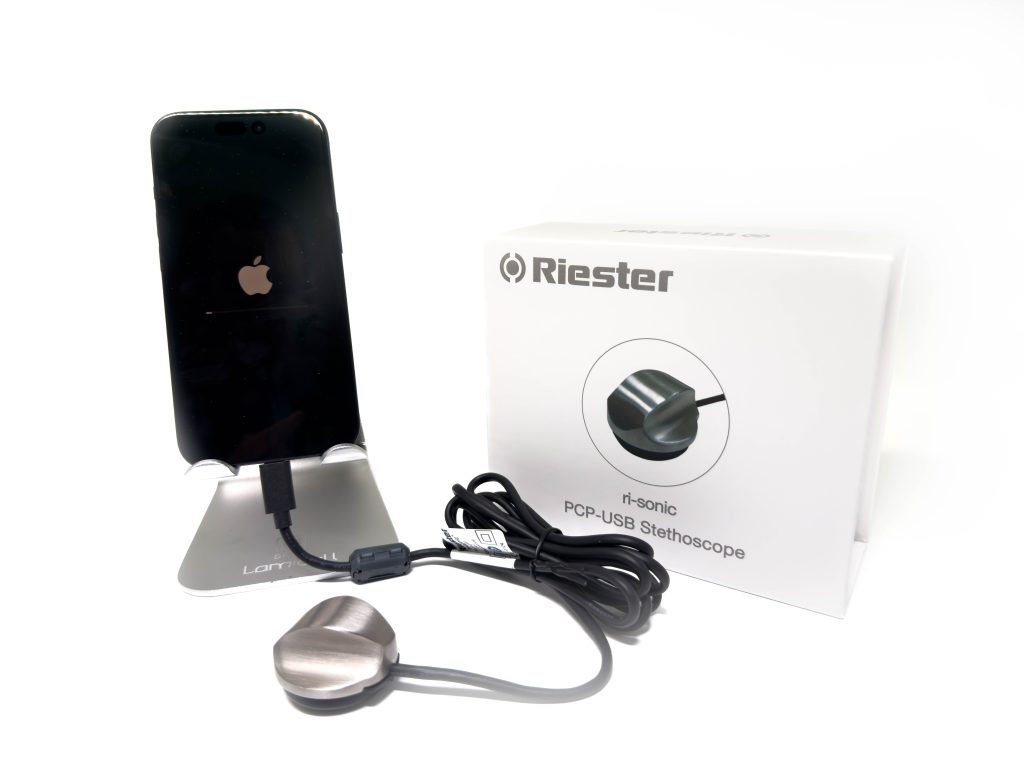
The Reister ri-sonic electronic stethoscope is a digital auscultation tool designed to integrate with modern clinical, telemedicine, and diagnostic workflows. The ri-sonic series of digital stethoscopes translates traditional acoustic signals into high-fidelity electronic output that can be listened to live or transmitted, recorded, and analyzed with compatible third-party software on PCs, tablets, or mobile devices.
While the ri-sonic range is available in multiple configurations, including analogue 3.5 mm jack, USB-A, USB-C, and optional legacy iOS adapter with varied cable lengths, this Innovation Watch focuses on the USB-C version of the ri-sonic (PCP-USB with USB-C connector). This variant is optimized for direct connection with USB-C-enabled laptops, tablets, and smartphones commonly used in telehealth settings.
The device’s integrated Analog/Digital converter and digital encoder ensure that acoustic signals captured at the chest piece are immediately digitized with minimal loss, making them suitable for live analysis and recording. USB-powered operation eliminates the need for batteries, simplifying device management in busy clinical environments and preventing complications of Bluetooth pairing.
Digital Auscultation Function
The ri-sonic USB-C electronic stethoscope supports a broad audio frequency range that is in line with other competing devices on the market. The total range is aligned with what the human ear can discern.
Unlike purely analogue scopes that rely on direct acoustic transmission, the ri-sonic converts acoustic input to digital signals at the point of capture. This allows for real-time playback, amplification, and data export on connected devices — an advantage for telemedicine setups where remote clinicians must assess sounds with clarity and nuance.
It is worth noting that without additional software-based filtering, the device outputs a fully amplified, unfiltered audio signal. In this raw state, the signal includes significant environmental and handling noise, limiting its clinical usefulness for auscultation without downstream processing.
Connected via USB-C, the device draws power from the connected device (laptop, mobile or tablet) without requiring its own battery source, enabling continuous use. Because the ri-sonic has no onboard controls or function buttons, all signal processing, including filtering, gain, and volume amplification, must be managed through software on the connected device.
Telemedicine and Workflow Integration
The ri-sonic has been designed for telemedicine applications, where remote auscultation, consultation, and collaboration are routine. Typical use cases include:
-
Teleconsultation with patients at home or in satellite clinics
-
Virtual cardiac and pulmonary examinations with specialist collaboration
-
Tele-expertise networks for diagnostic support
-
Remote monitoring programs that require high-quality auscultation data
Because the USB-C variant plugs directly into USB-C ports on modern tablets and PCs without adapters, it avoids compatibility challenges often encountered in telehealth deployments. This direct connection streamlines workflows for clinicians conducting remote exams or integrating auscultation data into telemedicine platforms.
Implementation Consideration:
Because the ri-sonic USB-C stethoscope relies entirely on host-based software for amplification, filtering, and audio management, successful deployment depends on selecting and validating compatible auscultation or telehealth platforms in advance. Clinical teams should ensure that endpoint devices, operating systems, and applications can reliably access USB audio input. Additionally, the telehealth platform software used with the device should provide appropriate signal processing before incorporating the device into routine workflows.
Mobile Device integration
Mobile devices present challenges related to implementing telehealth peripherals. Bluetooth pairing issues, battery life limitations, and reliance on vendor-specific apps have historically been barriers to implementing these devices for meaningful mobile (non-computer-based) use.
TTAC noted that during device testing, mobile operating systems (including Google Android, Apple iPadOS, and iPhoneOS) do not natively support USB input for external medical audio devices. As a result, mobile versions of standard video-conferencing platforms such as Zoom and Microsoft Teams are unable to access audio input from the stethoscope.
One notable exception is eMurmur, a vendor that is looking to solve this issue and allows for direct USB audio within their mobile Auscultation platform. During testing, the phone-based versions of the application proved more stable than tablet implementations. The platform successfully enabled mobile use of the ri-sonic and provided multiple filtering modes, including unfiltered (raw), Cardiac, Pulmonary, and Wideband.
TTAC plans to evaluate this platform in greater detail in a future Innovation Watch.
Product features, Descriptions, and Applications:
|
Feature |
Description |
Application |
|---|---|---|
|
Full audio bandwidth (20–2,000 Hz) |
Captures the full spectrum of auscultation sounds |
Enables accurate interpretation of subtle internal body sounds |
|
Digital A/D conversion at chest piece |
High-quality digital signal conversion |
Minimizes quality loss between capture and playback |
|
USB-C direct connectivity |
Simple plug-and-play setup |
Eliminates the need for adapters or external power |
|
USB-powered operation |
Constant power without batteries |
Reduces device downtime, maintenance burden |
|
Ergonomic, button-free design |
Minimal user interface complexity |
Reduces setup errors and supports easy integration in clinical workflows |
|
Multiple variants (USB-A, USB-C, 3.5-mm, iOS adaptor) |
Flexible platform for diverse environments |
Supports a wide range of clinical and telemedicine systems |
|
Medical-grade construction |
Engineered for safety and durability |
Suitable for routine daily clinical use |
Outcomes for Clinicians and Patients
For Clinicians
-
Enhanced Digital Auscultation: High-fidelity digital signal delivery supports detailed auscultatory assessment when paired with appropriate software and headphones.
-
Ease of Use: The modern USB-C plug-and-play design minimizes setup complexity in clinical and telehealth settings. The USB-C format is the expected standard for the forseeable future.
-
Improved Collaboration: Recordings can be shared for remote consultation, second opinions, and educational purposes.
For Patients
-
Improved Remote Diagnostic Experience: Enables high-quality auscultation in remote or underserved settings.
-
Longitudinal Monitoring: Recorded data supports trend analysis over time, depending on the platform that it is used with.
-
Reduced Diagnostic Uncertainty: High-quality recordings facilitate specialist review and clinical confidence.
Manufacturer Product Specifications
ri-sonic® USB-C Electronic Stethoscope:
-
Mode of Operation: Continuous operation
-
Electrical Protection: Class II protection against electrical shock
-
Auscultation Bandwidth / Frequency Range: 20 – 2,000 Hz
-
Classification: Type BF applied part
-
Weight: ~180 g (with cable)
-
Operating Conditions: 5 °C to 40 °C; relative humidity 30 %–75 %
-
Maintenance: No routine calibration or servicing required
-
Warranty: 2 years against material or manufacturing defects (conditions apply)
Connectivity & Configurations: Available in multiple connector types (3.5 mm analogue, USB-A, USB-C) and cable lengths (1.4 m, 1.8 m, 4 m, coiled), with optional adaptors for legacy iOS devices.
Manufacturer Website: ri-sonic® electronic stethoscope | Riester
Summary
The Reister ri-sonic USB-C electronic stethoscope bridges the gap between traditional auscultation and modern digital health workflows. With its broad audio capture range, USB-C connectivity, and flexible integration with clinical and telemedicine systems, it is a capable tool for clinicians seeking to elevate remote diagnostic examinations. Its family of configurations — including USB-A, 3.5 mm, and iOS adaptor options — ensures that it can fit into many clinical environments, while the USB-C model reviewed here delivers plug-and-play simplicity for today’s mobile and telehealth-centric practices.
Implementation Support and Next Steps
Successful deployment of digital auscultation tools like the ri-sonic requires more than device selection alone. Workflow integration, software compatibility, clinical use cases, and end-user training all play a critical role in long-term success.
For organizations seeking guidance, TTAC offers support with evaluation, implementation planning, and real-world testing of telehealth peripherals. Readers are encouraged to:
-
Reach out to TTAC directly (https://telehealthtechnology.org/request-technical-assistance/) for consultation and assistance with implementation strategy, or
-
Review TTAC’s implementation framework, Technology Assessment 101, which outlines a structured, vendor-agnostic approach to evaluating and deploying telehealth technologies in clinical environments.
This resource covers key considerations, including procurement, technical validation, clinical usability, and sustainability, helping teams move from pilot testing to successful operational use.
From time to time, TTAC will choose a piece of technology to show or demonstrate in the “Innovation Watch” section of our website. No endorsement of any products or services is expressed or implied by any information, hyperlink text, product, service, material, or content referred to or included on, or linked from or to the TTAC website.
From time to time TAC will choose a piece of technology to show or demonstrate in the “Innovation Watch” section of our website. No endorsement of any products or services is expressed or implied by any information, hyperlink text, product, service, material or content referred to or included on, or linked from or to the TTAC web site.