
Web-Based Cardiac Sound Analysis and Collaboration Tool
Platform Overview
As telehealth continues to mature, the conversation is shifting from “Can we connect?” to “Can we capture clinical quality data remotely?” The eMurmur platform is a web-based system for streaming, capturing, storing, and analyzing digital auscultation sounds, enabling clinicians to listen to heart, lung, and bowel sounds during a live session or review recordings later.
Unlike platforms focused primarily on real-time audio streaming, eMurmur emphasizes recording, comparison of ascultation sounds over time, and AI-assisted murmur detection. These features may be particularly relevant for cardiology consult workflows, clinical documentation, and teaching environments.
The platform operates through a web browser and can be accessed on computers, tablets, and mobile devices that meet the required operating system and browser specifications. The platform is also designed to optimize audio quality regardless of the digital stethoscope used.
Stethoscope Hardware Compatibility
One notable aspect of the platform is its ability to support multiple types of digital stethoscope hardware rather than requiring a single proprietary device.
During testing, the platform successfully recognized several common audio input methods, including USB digital stethoscopes and line-in digital stethoscopes connected through USB audio adapters or computer combo audio ports.
Because the platform relies on standard browser-based audio device recognition, organizations should be able to use a variety of compatible digital stethoscopes rather than being limited to a single hardware vendor. However, compatibility ultimately depends on whether the operating system recognizes the device as a supported USB audio input.
The platform also includes a dedicated configuration mode for the ThinkLabs One digital stethoscope and the Ri-Sonic (formerly RNK) USB stethoscope; these devices are widely used digital stethoscopes in telehealth deployments. During testing, this integration functioned reliably.
This hardware flexibility may be useful for organizations that already own digital stethoscope equipment or that want the option to evaluate multiple device types.
Auscultation Workflows
The platform supports both synchronous (live) and asynchronous (recorded) auscultation workflows.
Live Listening
Clinicians can listen to auscultation sounds in real time through a browser-based interface during a clinical encounter. However, additional technical considerations can arise when multiple participants need to listen to the same auscultation stream simultaneously. In order to overcome these challenges, the platform supports multiple simultaneous listeners, which may be useful in teaching environments or specialist consultations.
For example, a supervising physician and several trainees may be able to listen to the same auscultation session simultaneously. This option is not enabled by default, and must be activated within the platform’s web interface settings.
Recorded Auscultation
In addition to live listening, the platform is designed to capture and store recordings that can be reviewed after the patient encounter.
Clinicians are able to:
-
Listen to recordings after the session has ended
-
Download recordings for offline review or EHR/EMR upload
-
Compare multiple recordings within the same patient record
-
Share a unique link for a recording without any setup on the recipient’s part
The Compare feature allows multiple recordings to be displayed and played back within the same interface. This can support longitudinal comparison, such as evaluating baseline recordings alongside follow-up examinations.
Consult Review
The platform also includes an eConsult workflow designed for asynchronous specialist review. In this model, recordings can be captured by a clinician and later reviewed by a consulting cardiologist or specialist.
This type of workflow may align well with consult-based cardiology models where synchronous scheduling is not always practical.
Live Streaming Observations
The platform includes a browser-based live-streaming component for real-time auscultation.
During testing on the ANTHC enterprise network, the live-stream service was initially blocked by our firewall. eMurmur provides specific whitelisting guidance to address this; however, we did not deploy those changes and instead were able to use the platform on an open test network. This issue is worth flagging early, as enterprise security policies will commonly block the streaming component out of the box, and resolving it requires IT involvement.
Organizations should loop in IT before piloting, not after hitting the issue in a live environment.
Device and Mobile Experience
As with most digital auscultation systems, the physical hardware environment can influence usability and audio monitoring.
USB Stethoscopes and Mobile Devices
Local listening during auscultation is often preferred during clinical workflows. However, many modern mobile devices no longer include a 3.5 mm audio jack, which can make local monitoring more challenging when using USB-based digital stethoscopes. We tried a USB stethoscope on a tablet with a USB audio adapter, and the device wouldn’t allow output from the USB audio adapter. The USB Stethoscope was detected as its own audio device, leaving the OS unable to route output through the adapter at the same time.
The clearest mobile audio we got came from pairing an iPad Air (2022) with a Kensington StudioDock that provided both a powered USB hub and a headphone output. In this setup, audio playback quality was on par with PC-based listening.
However, the Kensington Studio dock has been discontinued. Alternatives are available, but organizations deploying mobile workflows may want to verify the audio monitoring capabilities of a dock during device selection and testing. Additionally, the dock hardware itself may need additional IT security and compatibility considerations.
Line-In Stethoscopes and Mobile Devices
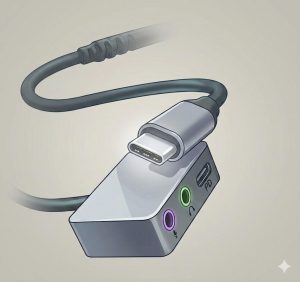
Mobile devices typically cannot support simultaneous line-in audio and headphone monitoring through a single audio port. eMurmur addresses this limitation by recognizing USB audio adapters that provide both a line-in port and a headphone output.
During testing, this configuration worked well with the ThinkLabs One digital stethoscope and with other line-in stethoscope devices connected through compatible USB audio adapters.
Generic example of a USB-C Audio adapter
Device Compatibility
The platform supports a range of device types as long as they meet the required operating system and browser requirements.
Supported mobile operating systems include:
-
Android devices running Android OS version 11 or higher
-
Apple devices running iOS or iPadOS version 15 or higher
The platform is designed to function within common web browsers, including Chrome, Firefox, and Microsoft Edge.
Because the platform operates through a browser and recognizes standard USB audio devices, it may also be compatible with nontraditional computing environments such as:
-
Thin client systems
-
ChromeOS devices
-
Telehealth carts or kiosk workstations
However, these configurations were not directly verified during testing. Compatibility may depend on whether the underlying operating system supports external USB audio devices.
Organizations may also want to ensure that mobile devices used with the platform are properly managed through a Mobile Device Management (MDM) system to maintain security and prevent unauthorized use.
AI-Assisted Murmur Detection
Recent updates to the eMurmur platform include automated heart sound analysis designed to support clinicians during auscultation review.
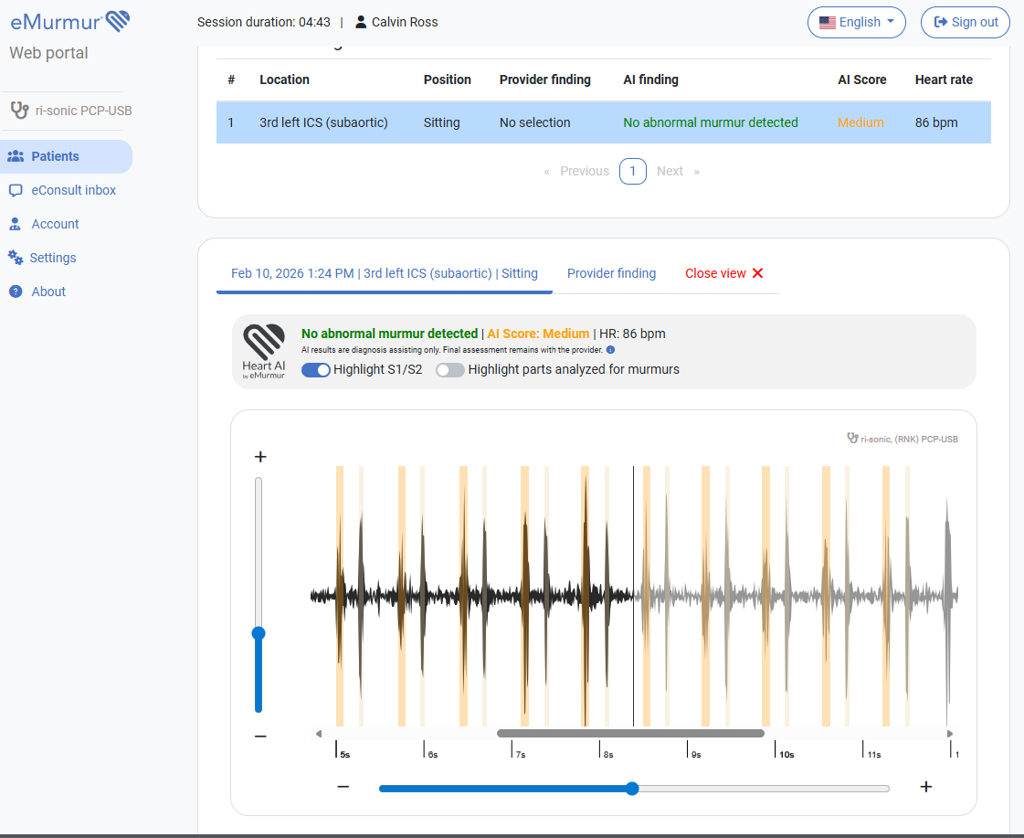
eMurmur Heart AI functions as a clinical decision support tool that analyzes recorded heart sounds to identify the presence or absence of abnormal murmurs. The analysis also identifies key cardiac components, including the first (S1) and second (S2) heart sounds, and measures heart rate as well as the relative intensity of systolic and diastolic phases.
Results are presented with a Heart AI Score, which indicates the reliability of the recording and whether the captured audio is suitable for interpretation or may need to be repeated.
Validation studies involving approximately 1,000 patients across the United States, Canada, and Europe reported approximately 90% sensitivity and specificity when compared with cardiologist interpretation and echocardiography reference standards.
eMurmur Heart AI is cleared as a Class II medical device through the U.S. FDA 510(k) process and is intended to support clinician interpretation rather than replace clinical judgment.
Manufacturer Website: emurmur.com
IT and Deployment Considerations
Organizations evaluating the platform may want to confirm several technical and operational factors before deployment.
These may include:
-
Device operating systems meet minimum requirements
-
Browser compatibility with organizational security policies
-
Whether non-traditional devices (such as thin clients or telehealth carts) will be used
-
Network firewall whitelist requirements
-
Whether asynchronous consult workflows align with clinical practice
Early coordination between clinical leadership, IT teams, and network security staff can help identify potential configuration issues before implementation. Additional implementation guidance is available in the TTAC resource: Technology Assessment 101 – Process Overview – TTAC
Broader Perspective
Digital auscultation platforms are evolving rapidly, and they don’t all solve the same problem. Some prioritize real-time streaming during a live telehealth visit; others are built around recording, structured storage, and asynchronous review. Knowing which workflow matters most to your organization is the most important question to answer before evaluating any platform.
eMurmur may sit closer to the recording-and-consult end of that spectrum. Live auscultation is supported, but the platform’s strengths are in structured storage, comparison over time, and AI-assisted review. These additional features matter more in cardiology consult workflows than in a primary care focused telehealth visit. However, the platform’s wide compatibility with different digital stethoscopes and web-based use make it a worthwhile consideration, even if the advanced consulting tools and AI analysis are a secondary focus.
Before evaluating any digital auscultation tool, it’s worth establishing what stethoscope hardware is already in use, how recordings will be documented or shared with specialists, and whether AI-assisted murmur detection is a priority. The answers will narrow the field considerably. Organizations that need help defining those requirements or structuring an evaluation can reach out to TTAC for assistance.
From time to time TAC will choose a piece of technology to show or demonstrate in the “Innovation Watch” section of our website. No endorsement of any products or services is expressed or implied by any information, hyperlink text, product, service, material or content referred to or included on, or linked from or to the TTAC web site.