
Why This Matters
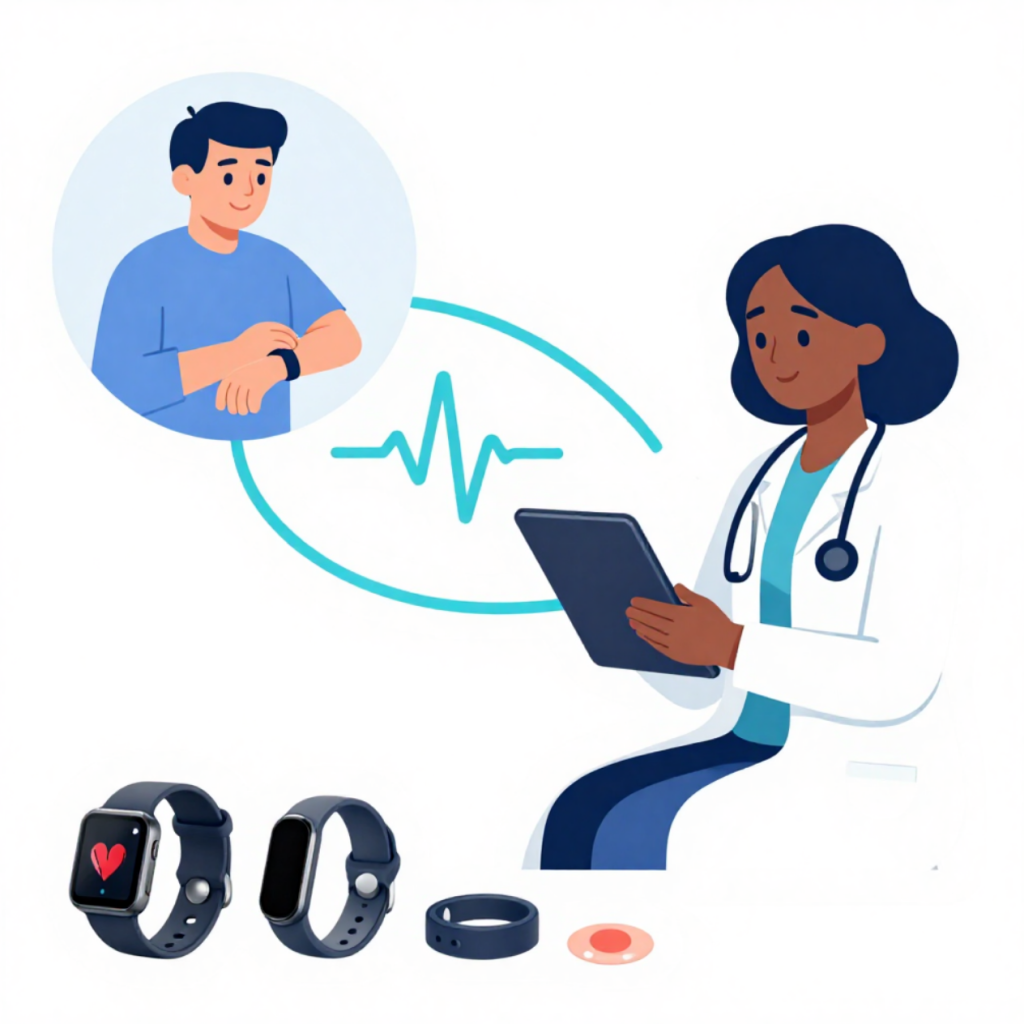
Consumer wearable devices, including smartwatches, smart rings, and fitness bands, are now a routine part of many patients’ daily lives. These tools collect activity, sleep, heart rate, temperature, and other physiological or behavioral signals that patients may bring into telehealth encounters through app dashboards, screenshots, alerts, summaries, or AI-generated interpretations.
For telehealth programs, the central question is not whether consumer wearables are useful or unreliable as a category. The more practical question is what kind of data is being presented, how it was generated, whether it has been independently validated, and what role it should play in care. Looking at changes over time for a single patient can help guide a more useful clinical conversation. Summary scores like readiness, recovery, stress, or sleep can be harder to interpret because it is often unclear how they are calculated or how reliable they are clinically.
The regulatory environment adds another layer of complexity. Many wearable features are marketed as general wellness tools rather than regulated medical devices, even when they present physiological measurements that appear clinical to patients. Other functions, such as certain ECG features or software that supports clinical decision-making, may fall under a different regulatory framework depending on the product’s intended use, claims, and interpretive function. As a result, telehealth programs cannot rely on device popularity, app presentation, or regulatory status alone as a proxy for clinical usefulness.
This snapshot focuses on consumer wearables in telehealth, with particular attention to evidence, regulatory classification, clinical interpretability, privacy, access, and practical program decision-making. It does not endorse any specific device, platform, or approach.
What Consumer Wearables Are
Consumer wearables include smartwatches, smart rings, fitness bands, and other app-connected devices designed for everyday health, fitness, and wellness tracking. These devices are generally purchased and managed by consumers rather than prescribed, provisioned, or monitored by a healthcare organization.
Smartwatches, including devices from companies such as Apple, Samsung, Fitbit, and Garmin, are typically interactive devices with screens, notifications, apps, and real-time data displays. Smart rings, including devices such as the Oura Ring and Samsung Galaxy Ring, are designed for more passive background sensing, often with longer battery life and a form factor suited to continuous wear, including overnight use. Fitness bands generally provide a lower-cost and less complex version of activity, heart rate, and sleep tracking.
Across these form factors, many devices use a similar set of sensors. Accelerometers detect movement and support step counts, activity estimates, sleep timing, and sedentary behavior tracking. Photoplethysmography, often referred to as PPG, uses optical sensing to estimate heart rate and related measures. Some devices also include skin temperature sensors, blood oxygen saturation estimates, electrodermal activity sensors, or single-lead ECG features.
For telehealth programs, it is useful to separate the underlying signal from the interpretation presented to the user. A wearable may collect data related to movement, sleep timing, resting heart rate, or heart rate variability. The app may then convert those signals into user-facing summaries such as a sleep score, readiness score, recovery score, stress score, or AI-generated health explanation. The underlying trend may be useful as part of a clinical conversation, but the summary score or interpretation may not be independently verifiable by the provider.
This distinction matters because patients often experience wearable outputs as health information, while clinicians and programs need to determine whether the information is a measured value, a calculated estimate, a proprietary score, or a regulated clinical function.
How Wearable Data May Show Up in Telehealth
 Telehealth programs most often encounter consumer wearable data when patients bring it into a clinical encounter themselves. A patient may reference a smartwatch alert, show a sleep or heart rate trend from an app, share a screenshot, or ask about an AI-generated summary connected to their wearable data. In these situations, the program has no prior history with the device or data, but the provider is still being asked to respond to the information.
This creates a practical challenge. Patients may view wearable data as part of their health record, while providers may not know how the device collected the data, how the app calculated a score, or whether the output has been validated for clinical use. A patient’s concern may be legitimate even when the wearable interpretation is not clinically reliable. For example, a low recovery score may not be independently meaningful, but the patient’s report of poor sleep, fatigue, or a sustained change in resting heart rate may still warrant a clinical discussion.
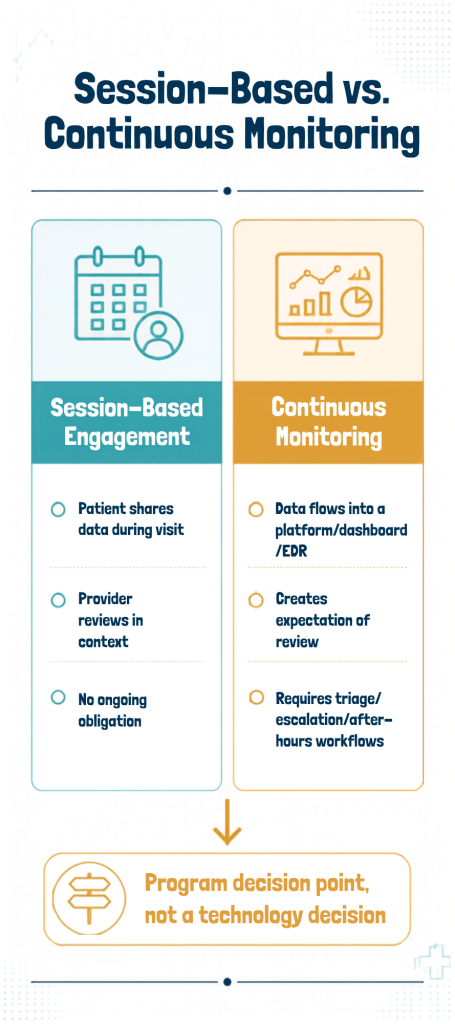
Programs can reduce confusion by distinguishing between session-based engagement and continuous monitoring. In a session-based model, the patient shares wearable data during a visit as a conversation prompt. The provider can review the information in context, ask follow-up questions, and decide whether the underlying pattern is clinically relevant. This approach does not require the program to continuously receive, review, or act on wearable data outside the encounter.
Continuous monitoring is a different operational model. If wearable data flows into a clinical platform, remote monitoring dashboard, vendor portal, or electronic health record, the program may create a patient expectation that someone is reviewing that data and responding to concerning changes. This requires defined workflows for triage, escalation, documentation, after-hours coverage, and patient communication. Without those workflows, programs risk collecting data they are not prepared to interpret or act on.
For many telehealth programs, the first step is not deciding whether to formally adopt consumer wearables. It is developing a clear position on how providers should respond when patients bring wearable data into care.
What the Evidence Supports
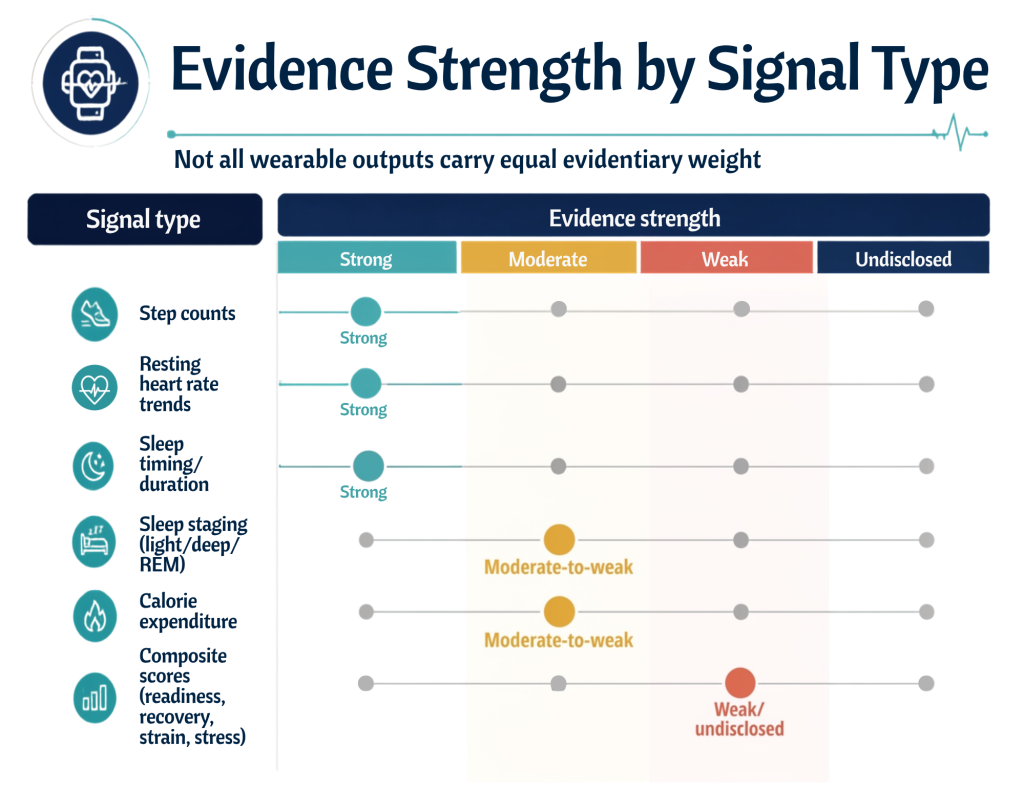 The evidence base for consumer wearables varies by the type of signal, the device being studied, the population included in the research, and whether the study measured technical accuracy or clinical outcomes. Programs should be cautious about treating validated as a general label. A device may perform reasonably well for one measure, such as step count or resting heart rate, while performing less reliably for another, such as calorie expenditure or sleep staging.
Consumer wearables are generally strongest when used to identify broad patterns over time. Step counts, activity patterns, sleep timing, sleep duration, and resting heart rate trends have more support in the published literature than many higher-level app interpretations. These signals may be useful in telehealth encounters when they are viewed as longitudinal trends, especially when compared with a patient’s own baseline rather than with population norms. [2]
The evidence is weaker for outputs that require more complex interpretation. Calorie expenditure estimates have shown substantial error across devices. Sleep staging, including estimates of light, deep, and REM sleep, is less reliable than broad sleep/wake detection. Composite scores such as readiness, recovery, strain, stress, or sleep scores are especially difficult to interpret clinically because manufacturers often do not disclose how the scores are calculated, how different inputs are weighted, or whether the score has been independently validated for healthcare use. [1,2,3,4]
A practical distinction for programs is the difference between measurement accuracy and clinical usefulness. A wearable may detect a change in sleep timing, activity, or resting heart rate, but that does not automatically mean the program has evidence-based thresholds for action or a defined intervention that improves outcomes. Monitoring alone is not the same as care. Wearable data becomes more useful when it is connected to a clear clinical question, a defined workflow, and a response pathway. [5,6]
The most defensible use of consumer wearable data in telehealth is often as a conversation prompt or longitudinal context rather than as a stand-alone basis for diagnosis, screening, or treatment decisions. A provider may reasonably discuss changes in a patient’s sleep pattern, activity level, or resting heart rate trend without accepting a proprietary score or AI-generated interpretation as clinically valid. [2]
Composite Scores and AI Interpretation
Many consumer wearable platforms present health information through proprietary scores rather than through raw measurements alone. Readiness, recovery, strain, stress, energy, and sleep scores may combine sleep timing, heart rate, heart rate variability, activity, temperature, and other signals into a single number or category. These scores can be useful to consumers as general wellness feedback, but they are difficult for clinicians to independently interpret. [1]
The challenge is that composite scores often depend on formulas that are not publicly disclosed. Providers may not know which inputs were used, how those inputs were weighted, whether the score was validated against a clinical reference standard, or whether the score performs consistently across different populations. A score that appears precise in an app may not have the transparency or validation needed to support clinical decision-making. [1]
AI-generated summaries add another layer of interpretation. Some platforms now use wearable data to produce natural-language explanations, coaching prompts, risk suggestions, or wellness recommendations. These outputs may make the data feel more clinically meaningful to patients, even when the system is operating as a wellness tool rather than a regulated medical device or clinical decision support function.
For telehealth programs, the practical response is to separate the patient’s concern from the platform’s interpretation. A low readiness score, elevated stress score, or AI-generated warning may not be independently meaningful. However, the underlying issue that led the patient to raise the concern may still matter. Poor sleep, increased fatigue, reduced activity, sustained elevation in resting heart rate, or a noticeable change from the patient’s usual baseline may support a useful clinical conversation.
Programs do not need to dismiss wearable data outright. They do need to be clear about what can and cannot be interpreted. Providers can acknowledge the patient’s concern, ask what changed, look for underlying trends, and avoid treating proprietary scores or AI-generated summaries as validated clinical findings unless there is evidence and workflow support for doing so.
Regulatory Framework: Wellness, Clinical Decision Support, and Medical Devices
Consumer wearables are often described as wellness products, but the regulatory picture is more specific than the device category alone. Regulatory status generally depends on the function being offered, the claims made by the manufacturer, and the intended use of the software or device feature. The same wearable may include some functions that are positioned as general wellness tools and others that are subject to medical device oversight.
General wellness functions are intended to support healthy lifestyle awareness or encourage general health behaviors. Examples may include activity tracking, sleep summaries, stress awareness, recovery feedback, or general fitness coaching. These functions are typically not regulated as medical devices when they avoid diagnosis, treatment, mitigation, or management claims for a specific disease or condition.
Clinical decision support functions provide information that may help a healthcare professional make decisions about a patient’s care. Whether a CDS function is regulated depends in part on whether the clinician can independently review the basis for the recommendation. Tools that present transparent information for clinician review are treated differently than tools that provide opaque or single-output recommendations that cannot be independently evaluated.
Software as a Medical Device, or SaMD, refers to software intended for a medical purpose without being part of a hardware medical device. In the wearable context, this may include software that analyzes sensor data to detect, diagnose, monitor, or support management of a specific disease or condition. These functions carry a higher regulatory burden because the software is making or supporting claims that go beyond general wellness awareness.
For telehealth programs, the central point is that regulatory classification follows intended use and product claims, not simply the sensor. A heart rate sensor, ECG function, sleep signal, or activity measure may be used in a wellness context, a clinical decision support context, or a regulated medical device context depending on how the function is designed, marketed, and used.
This distinction matters because patients may not see the difference. A feature that appears clinical in an app may still be marketed as a wellness function. Conversely, a specific function on a consumer device may have undergone regulatory review while other features on the same device have not. Programs should avoid treating the device as a single regulatory category and instead evaluate the specific function, claim, and use case being considered.
Why the Regulatory Line Matters for Programs
The distinction between wellness, clinical decision support, and regulated medical device functions matters because it affects what evidence a program can reasonably assume exists. A wellness feature may be useful to a patient, but it has not necessarily been reviewed for clinical accuracy, safety, or effectiveness. A regulated function may have been reviewed for a specific intended use, but that review does not automatically apply to every feature on the device or every way a program might use the data.
This creates a practical risk for telehealth programs. Consumer wearable outputs can look clinical even when they are not intended or validated for clinical decision-making. A patient may interpret an alert, score, or AI-generated explanation as a medical finding, while the manufacturer may describe the same feature as general wellness information. Providers can then be placed in the position of responding to data that appears medically relevant but lacks the transparency, validation, or regulatory status needed to support clinical action.
Programs should not use regulatory status as a shortcut for technology assessment. FDA clearance of a specific feature may be important, but it does not validate the entire platform. The absence of FDA clearance does not automatically mean a feature is useless, but it does mean the program must be more cautious about how the information is interpreted and documented. Similarly, a wellness label does not make a feature harmless if patients or providers begin using it to guide care decisions.
A defensible program approach starts by asking what function is being used, what claim is being made, what evidence supports that claim, and what role the information will play in care. The more a wearable output influences triage, diagnosis, treatment, documentation, or patient instructions, the more scrutiny the program should apply.
Access, Privacy, and Population Fit
Consumer wearables are not evenly accessible across patient populations. Many devices are purchased out of pocket, require a compatible smartphone, depend on app-based setup, and may involve ongoing subscription costs. For programs serving rural, frontier, tribal, older adult, or lower-income populations, the primary access barrier may be cost and usability rather than geography alone. Patients who could benefit from longitudinal trend awareness may be least able to purchase, maintain, or interpret consumer wearable devices independently. [8]
Programs should also consider whether the evidence behind a wearable function applies to the population being served. Many validation studies have been conducted in limited populations and may not reflect older adults, patients with multiple chronic conditions, rural or frontier populations, or racially and ethnically diverse communities. Optical sensors such as PPG may perform differently depending on skin tone, motion, perfusion, device fit, and wear conditions. These factors do not make wearable data unusable, but they do mean programs should be cautious about assuming that published accuracy figures apply equally across all patients. [2]
Digital literacy is another practical concern. A device may be passive once configured, but patients may still need to install apps, manage permissions, charge the device, respond to alerts, understand summaries, export data, or share information during a telehealth visit. These tasks may be difficult for patients who are less comfortable with smartphones or who rely on caregivers for technology support. [8]
Privacy and data governance require separate attention from device accuracy. When patients use consumer wearable platforms independently, their data is generally governed by the platform’s terms of service and privacy policy rather than by the healthcare organization’s HIPAA obligations. If a healthcare organization begins collecting, documenting, importing, or acting on wearable data, the governance context may change. Programs should be clear about what data is reviewed, whether it becomes part of the medical record, who can access it, and what patients are told about the limits of privacy protections. [7]
For some populations, privacy concerns may be a major barrier to trust. Consumer health data may include sensitive information about sleep, activity, location patterns, reproductive health, stress, or inferred health status. Programs should avoid assuming that patients are comfortable sharing wearable data simply because they own a device. A patient-centered approach should account for cost, usability, connectivity, language access, caregiver support, cultural context, and data privacy concerns before treating consumer wearable data as a routine part of care.
Practical Questions for Program Decision-Makers
Consumer wearable data is most useful when programs are clear about the role it is expected to play. Before adopting, integrating, recommending, or routinely responding to wearable data, programs should define whether the data will be used as a conversation prompt, a source of longitudinal context, a monitoring input, or a clinical decision support tool. Each use case carries different evidence, workflow, documentation, privacy, and liability considerations.
Programs may find the following questions useful when developing an internal position on consumer wearable data:
- What clinical or operational need would wearable data address in our program?
- Are we responding to patient-owned devices, considering program-provided devices, or evaluating a formal integration with clinical systems?
- Which outputs would providers be expected to interpret: raw measurements, longitudinal trends, alerts, proprietary scores, or AI-generated summaries?
- What evidence supports those outputs, and was that evidence generated in populations similar to the patients we serve?
- Is the relevant function being marketed as a general wellness feature, clinical decision support, or a regulated medical device function?
- Are providers prepared to explain the difference between wellness data, patient-reported information, and clinically validated measurements?
- If wearable data suggests a meaningful change in a patient’s status, who receives that information, when is it reviewed, and what response pathway follows?
- Would wearable data be documented in the medical record, and has the program addressed privacy, consent, and data governance implications?
- How do cost, device access, digital literacy, connectivity, language access, caregiver support, and privacy concerns affect equitable use in the populations we serve?
- Are we creating patient expectations that wearable data will be continuously reviewed or acted on outside the clinical encounter?
For many programs, a practical starting point is a clear policy for session-based discussion of patient-generated wearable data. This allows providers to acknowledge patient concerns, review trends in context, and escalate when clinically appropriate without creating a monitoring infrastructure the program is not prepared to support.
TTAC Resources
Consumer Wearables Webinar
TTAC produced a webinar, The Potential of Wearables: Bridging Data and Disease Management, addressing the consumer wearable landscape, measurement accuracy, chronic disease applications, and the regulatory context covered in this snapshot.
Technology Assessment 101 Toolkit
Programs preparing to evaluate a consumer wearable, digital health tool, or patient-generated data workflow can use TTAC’s Technology Assessment 101 Toolkit to guide needs assessment, testing, stakeholder review, and implementation planning.
Home Telehealth Toolkit
Programs considering organization-provided monitoring devices or structured home monitoring workflows may also find TTAC’s Home Telehealth Toolkit useful for device selection, deployment, training, support, and program operations.
References
- Doherty C, Baldwin M, Lambe R, Burke D, Altini M. Readiness, recovery, and strain: an evaluation of composite health scores in consumer wearables. Translational Exercise Biomedicine. 2025;2:128-144. doi:10.1515/teb-2025-0001
- Doherty C, Baldwin M, Keogh A, Caulfield B, Argent R. Keeping pace with wearables: a living umbrella review of systematic reviews evaluating the accuracy of consumer wearable technologies in health measurement. Sports Medicine. 2024;54:2907-2926. doi:10.1007/s40279-024-02077-2
- Stiles VH, Grau L, Chow JY, et al. Reliability and validity of commercially available wearable devices for measuring steps, energy expenditure, and heart rate: systematic review. JMIR mHealth and uHealth. 2020;8(9):e18694. doi:10.2196/18694
- de Zambotti M, Goldstone A, Claudatos S, Colrain IM, Baker FC. A validation study of Fitbit Charge 2 compared with polysomnography in adults. Chronobiology International. 2018;35(4):465-476. doi:10.1080/07420528.2017.1413578
- Faurholt-Jepsen M, Frost M, Christensen EM, Bardram JE, Vinberg M, Kessing LV. The effect of smartphone-based monitoring on illness activity in bipolar disorder: the MONARCA II randomized controlled single-blinded trial. Psychological Medicine. 2020;50(5):838-848. doi:10.1017/S0033291719000710
- Faurholt-Jepsen M, Tonning ML, Fros M, et al. Reducing the rate of psychiatric re-admissions in bipolar disorder using smartphones: the RADMIS trial. Acta Psychiatrica Scandinavica. 2021;143(2):163-175. doi:10.1111/acps.13253
- Doherty C, Baldwin M, Lambe R, et al. Privacy in consumer wearable technologies: a living systematic analysis of data policies across leading manufacturers. npj Digital Medicine. 2025;8:363. doi:10.1038/s41746-025-01757-1
- Pew Research Center. Internet/Broadband Fact Sheet. 2024. Available at: https://www.pewresearch.org/internet/fact-sheet/internet-broadband/