update May 2026
Why This Matters
Auscultation remains one of the most familiar elements of the physical exam, and one of the hardest to replicate at a distance. For decades, the electronic stethoscope category in telehealth was defined by a relatively simple promise: capture heart and lung sounds locally and make them available to a remote clinician. Devices improved incrementally, but workflows often remained complicated and adoption stayed uneven.
The category is now showing more meaningful change. Rather than converging around a single device type or workflow model, digital auscultation is becoming more modular. Hardware used to capture sounds, platforms used to transmit or store them, and emerging tools used to analyze recordings are increasingly being developed as separate parts of a broader ecosystem. This shift has practical implications for how telehealth programs evaluate, deploy, and sustain auscultation capability.
Several recent developments are particularly notable: browser-based auscultation platforms that work with multiple stethoscope devices, out-of-band audio transmission systems designed to avoid the limitations of standard video conferencing audio, and growing interest in software tools that support recording review, comparison, and, in some cases, AI-assisted analysis. Taken together, these changes are encouraging. They may give healthcare organizations more flexibility than earlier, tightly coupled stethoscope systems, while also creating new questions about compatibility, workflow, and long-term support.
For telehealth programs currently using older stethoscope hardware, relying on proprietary single-vendor platforms, or considering whether digital auscultation fits their care model, this is a useful moment to reassess where the technology stands.
What It Is: The Electronic Stethoscope Today
At its core, an electronic stethoscope converts acoustic body sounds, most commonly heart and lung sounds, into digital signals that can be amplified, filtered, recorded, and transmitted. That basic function has not changed. What is changing is how those signals are handled after capture, and how much flexibility organizations have in combining hardware and software tools.
Many telehealth stethoscope deployments have historically relied on closely linked systems: a specific device paired with a specific software environment or transmission workflow. That model remains common, and it may still work well in some settings. However, newer approaches are beginning to separate the major functions involved in digital auscultation.
A complete telehealth auscultation workflow may include:
- A capture device — the stethoscope or sensor that collects body sounds
- A transmission or workflow platform — the pathway used to stream, record, store, review, or share those sounds
- An analytics layer — optional software tools that assist with interpretation, pattern recognition, or clinical documentation
Not every solution includes all three. Not every program needs all three. The key evaluation question is increasingly less about finding the “best” electronic stethoscope and more about identifying which components are needed for a given care model, how well they work together, and what operational demands they create.
Three Functional Layers for Digital Auscultation
Digital auscultation workflows can be understood across three functional layers: hardware capture, audio transmission and platform workflow, and analytics or decision-support tools.
Layer 1: Hardware Capture
The hardware used for digital auscultation varies more than it once did. Electronic stethoscopes may be designed as traditional tubed devices, compact digital sensors, or wireless systems intended for use with companion applications or broader telehealth platforms. Connection models also differ, including Bluetooth, USB, and analog-to-digital adapter workflows.
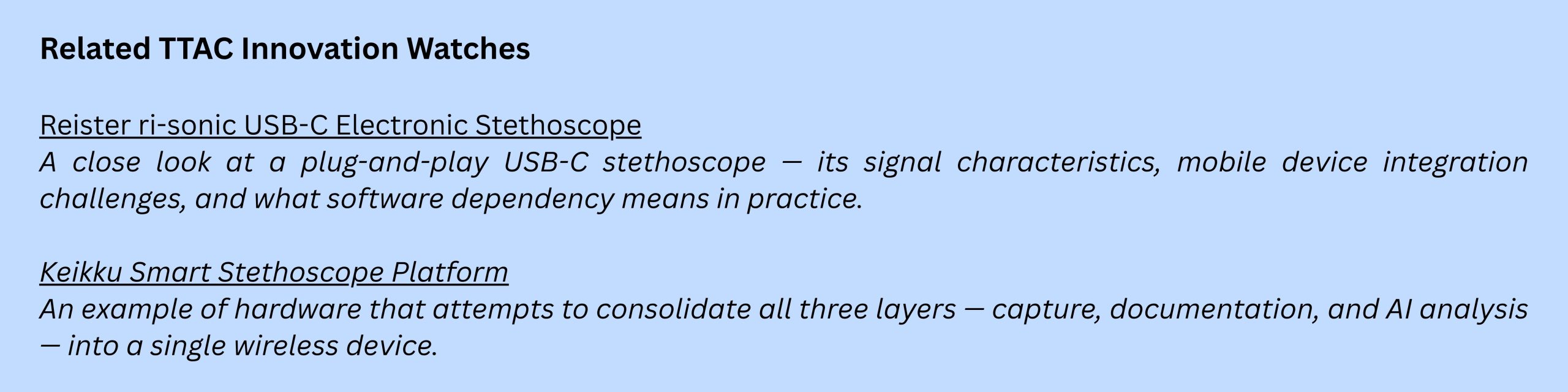
USB-connected digital stethoscopes represent one increasingly visible approach. These devices can draw power directly from the connected computer or mobile endpoint and avoid some of the battery management and pairing issues associated with wireless models. In many cases, however, they rely heavily on software at the host device or platform level to process, filter, and manage the audio signal. This dependence makes compatibility with the intended software environment especially important.
Bluetooth-enabled devices remain common and may offer advantages in mobile or cart-based deployments where a wired connection is less practical. These systems can provide a more self-contained listening experience, but they may also introduce additional considerations related to pairing, charging, and connection reliability.
Some platforms are also exploring ways to support existing or legacy stethoscope hardware through adapter-based workflows. Where available, this may help organizations extend prior equipment investments, though performance and compatibility should be evaluated carefully in the intended use environment.
Key questions for the hardware layer:
- How does the device connect: USB, Bluetooth, or another method?
- What does that connection model mean for setup, charging, pairing, and IT support?
- Does the intended software platform support the device?
- What form factor best fits the clinical workflow?
- Can any existing stethoscope inventory be used or adapted, and is the resulting workflow acceptable?
Layer 2: Audio Transmission
Transmission is one of the most important practical considerations in telehealth auscultation, and one area where newer approaches are addressing longstanding limitations.
In-band audio transmission:
In-band audio transmission uses the existing audio channels of a video platform to transmit stethoscope audio. This method presents a core challenge: standard video conferencing platforms such as Zoom, Teams, or similar tools are engineered for human speech. Their noise suppression, automatic gain control, and compression algorithms are optimized to make voices clearer. However, those same algorithms can flatten, distort, or remove the low-frequency signals that carry diagnostic information in cardiac and pulmonary sounds. Some of these processing features can be reduced or disabled, but the conferencing audio layer may still affect what the remote clinician hears.
This method may still be valid for some use cases. In many clinical scenarios, particularly in primary care or where the goal is to support a remote consultation rather than reproduce every aspect of an in-person exam, in-band audio through a standard video platform may be sufficient. Programs should make that determination deliberately rather than by default.
Out-of-band transmission:
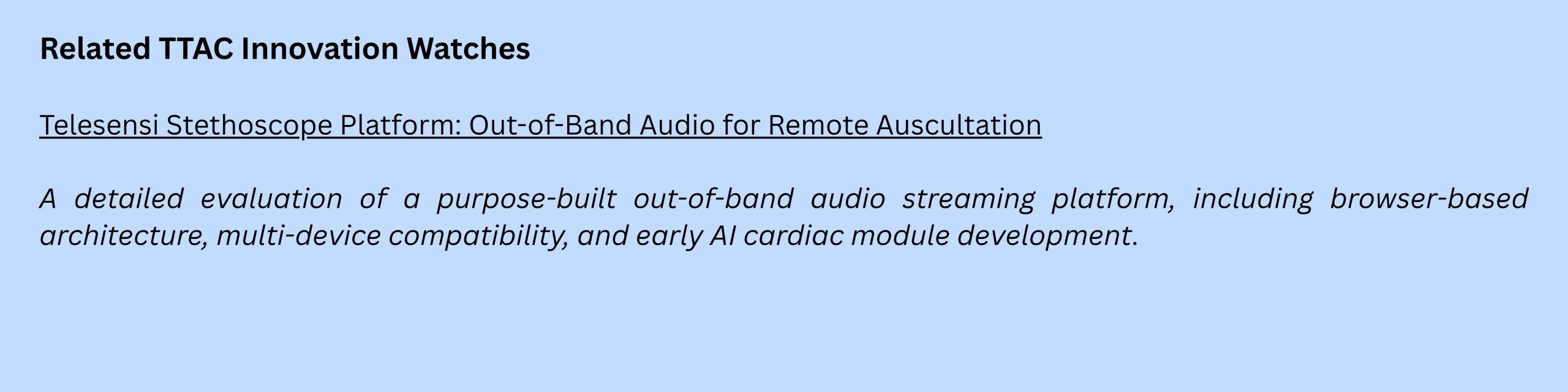
Out-of-band audio transmission addresses this limitation by routing stethoscope audio through a separate, dedicated channel independent of the video conferencing platform. The remote clinician typically uses a second browser tab or application alongside the video visit. Because the stethoscope signal is not routed through the conferencing platform’s speech-optimized audio path, these systems may preserve more of the auscultation signal and allow voice and stethoscope audio to be managed separately in real time.
This approach introduces its own operational layer: there is now a second application to launch, a session to initiate, and a connection to establish and maintain. For some programs, that added overhead may be manageable. For others, it represents a meaningful requirement for workflow coordination.
Key questions for the transmission layer:
- Is real-time remote auscultation a core use case, or can stethoscope sounds be recorded and forwarded to the listening provider?
- Has the clinical team compared in-band vs. out-of-band audio quality with the stethoscope devices in use?
- Has IT looked at the proposed solution? Out-of-band platforms may require firewall whitelisting and other changes to network configuration to allow for the software to function properly.
- What is the operational capacity for managing a second concurrent application during a live clinical encounter?
Layer 3: Analytics and Intelligence
Analytics and intelligence tools are one of the areas of fastest change in the electronic stethoscope space, and they are likely to remain a major focus of future development.
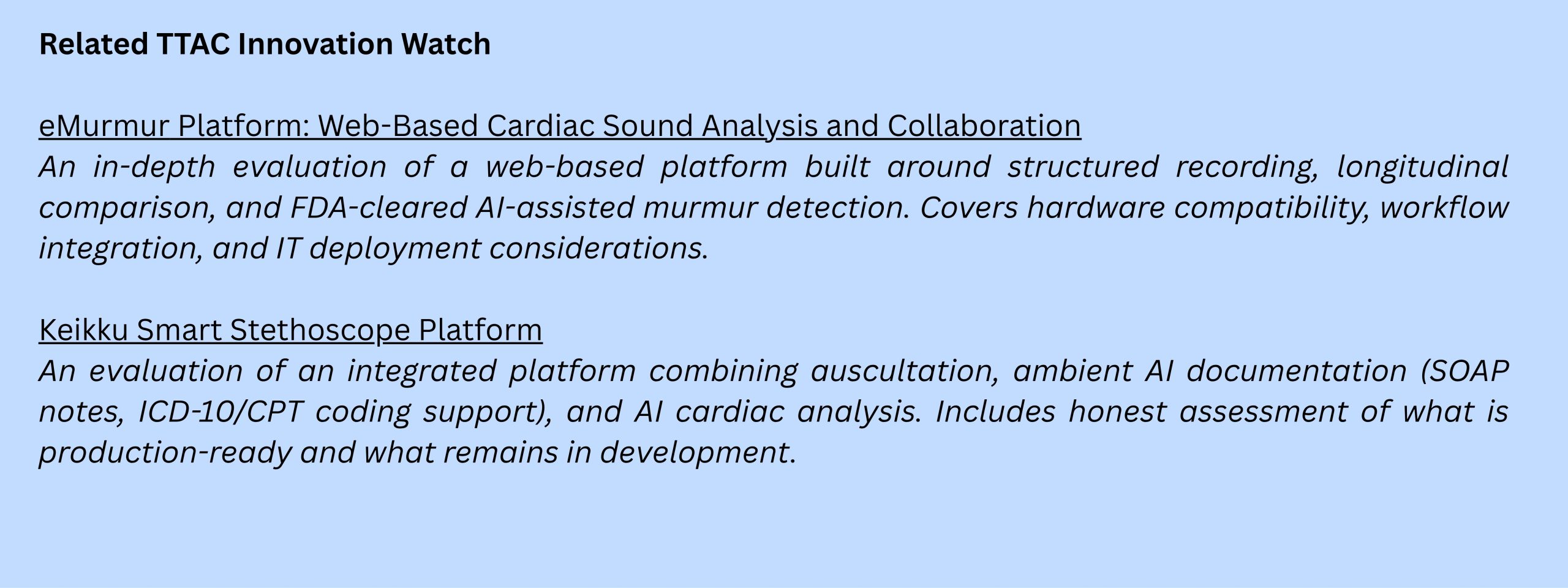
AI-assisted cardiac sound analysis is becoming more visible in the electronic stethoscope space. Some tools can analyze recorded heart sounds for findings such as murmurs, identify basic cardiac sound features, and provide information about recording quality. These capabilities are beginning to appear both in dedicated analysis platforms and as part of broader digital auscultation workflows.
As these tools introduce new clinical data into the auscultation workflow, organizations may need to revisit how that information is reviewed, documented, and acted upon. A tool that flags a possible murmur or identifies a low-quality recording is only useful if the care process accounts for that output. Programs evaluating analytics features should consider where results appear, who is expected to review them, and what follow-up steps may be required.
Key questions for the analytics layer:
- Is AI-assisted analysis of heart or lung sounds relevant to the intended use case?
- What findings or outputs does the tool generate, and how are they intended to support clinical review?
- What is the regulatory status of any analytic capability being evaluated?
- Where do results appear in the workflow, who reviews them, and what follow-up process is expected?
- Are analytics features included in the base product or available only through additional licensing or subscription costs?
Healthcare Use Cases:
Digital auscultation in telehealth is not a single-use-case technology. The clinical scenarios that motivate adoption differ significantly — and they map unevenly onto the three-layer model described above. Understanding which scenario best describes your program is the most important step in evaluating which combination of hardware, transmission, and analytics capability actually fits.
Remote Clinical Encounters
The most common telehealth auscultation scenario: a nurse, medical assistant, technician, or community health worker places the stethoscope at the patient site while a remote clinician listens and directs the exam. Real-time audio quality matters most here, and the transmission layer — including the decision between in-band and out-of-band — has the most direct impact on clinical experience. This use case is well-supported by both traditional platform-coupled devices and newer out-of-band streaming solutions.
Store-and-Forward Consultation
Heart or lung sound recordings are captured during an encounter and shared with a specialist for asynchronous review. The capture and platform layers matter most. Audio quality at the point of recording, reliable storage, and the ability to share and compare recordings drive value here. This is also where analytics-layer capabilities like AI-assisted murmur detection and longitudinal comparison are most naturally integrated. A specialist reviewing a recording benefits from both a clean audio file and a supporting decision support signal
Longitudinal Cardiac Monitoring
Some programs use digital auscultation to track cardiac sounds over time, flagging changes that might indicate disease progression or treatment response. This is the scenario where platforms built around structured recording, annotation, and comparison — rather than just real-time streaming — have the strongest value proposition. AI-assisted analysis is particularly relevant here, as automated comparison of a new recording against a documented baseline is a meaningful clinical capability that manual review alone cannot efficiently replicate at scale.
Education and Clinical Training
Because digital stethoscopes can record, replay, and share sounds, they have natural applications in training environments. Multi-listener capability (the ability for a supervisor and multiple trainees to listen simultaneously to the same live or recorded auscultation) is a differentiating feature in platforms targeting this use case.
Key Selection Criteria
Evaluating electronic stethoscopes for telehealth requires thinking across all three functional layers simultaneously. The most common mistake in this category is selecting hardware first and solving for everything else later. The questions below are intended to surface the decisions that matter most before any specific product evaluation begins.
Clinical Fit
- What is the primary clinical workflow — real-time remote exams, store-and-forward consultation, longitudinal monitoring, or documentation integration?
- Is the goal to extend diagnostic reach to remote sites, reduce documentation burden, or both?
- Will the remote clinician be listening live, reviewing recordings asynchronously, or relying on AI-assisted findings as a decision support layer?
- Has the clinical team had hands-on experience listening to the actual devices under consideration? Audio quality perception is partly subjective — clinicians acclimated to one acoustic profile may find another disorienting even if both are technically adequate.
Transmission and Audio Fidelity
- Will auscultation audio travel in-band through a video conferencing platform, or through a dedicated out-of-band channel?
- Has the team tested both and listened to the difference with the stethoscope hardware being evaluated?
- For in-band, what compression, noise suppression, or gain control settings are applied by the video platform, and can they be modified?
- Does the out-of-band solution require firewall changes, and has IT been looped in before the evaluation rather than after?
Platform and Software
- What hardware does the platform support? Does the platform support multiple types of stethoscopes, or is it limited to proprietary devices?
- Is the platform browser-based, app-based, or software-installed — and what are the implications for IT management, device compatibility, and thin client or telehealth cart environments?
- What are the minimum OS and browser requirements, and do they align with what is deployed across the organization?
- How are recordings stored, labeled, and shared? Does the workflow fit clinical practice, or does it require significant behavioral change?
- What level of EHR integration is available — and what is required to activate it? API configuration, third-party integration middleware, and IT capacity are all relevant variables.
Analytics and AI Capabilities
- Is AI-assisted murmur detection required, desired, or out of scope for this program?
- What is the FDA clearance status of the AI feature, and what clinical governance framework should govern its use?
- Are AI features included in the base price, or subscription-gated? What is the total cost of ownership at the intended scale?
Operational and Financial Considerations
- What is the training requirement for clinical and support staff, particularly around device controls, software platforms, or AI-generated output review?
- What happens when a device needs to be replaced, re-paired, or troubleshot at a remote site? Is there a documented process?
- Is the pricing model device-only, device-plus-subscription, or tiered by feature? Model costs at actual deployment scale, not pilot scale.
- What reimbursement pathways, if any, apply to remote auscultation services in the program’s clinical context?
- What is the vendor’s track record for support responsiveness — particularly at geographically remote or tribal sites where on-site troubleshooting is not a practical option?
Compliance and Risk
- HIPAA alignment: does the platform encrypt audio data in transit and at rest? Where is data stored?
- For AI clinical decision support: are outputs clearly labeled as decision support rather than diagnosis? How are edge cases and low-confidence results surfaced?
- Cybersecurity: Bluetooth-enabled devices and cloud-based platforms each introduce distinct attack surfaces. Confirm that the platform has been evaluated within the organization’s security framework.
Advantages and Limitations
Advantages:
The most durable advantage of electronic stethoscopes in telehealth is extended clinical reach. A skilled remote clinician who can listen to a patient’s heart and lungs during a virtual encounter is capable of something fundamentally different from a video visit alone. In underserved settings, tribal communities, and rural health systems where specialist access is genuinely limited, that capability matters.
What is new is the degree to which that reach is now augmentable. A recording made during a remote encounter can be reviewed by a cardiologist later in the day. An AI screening tool can flag a potential murmur before the recording leaves the point-of-care device. These are not incremental improvements to a single device. These changes are structural additions to what a digital auscultation workflow can accomplish.
The growing ability for platforms to support a variety of stethoscope hardware also may reduce vendor lock-in for organizations willing to evaluate platform options. Programs that have invested in existing stethoscope hardware may find that newer platforms can extend the useful life of those devices while adding capabilities they did not originally support.
Limitations:
Audio quality remains a persistent challenge in this category, and it cannot be fully resolved by hardware specifications alone. The entire signal chain: capture device, connection method, transmission pathway, conferencing platform, and output device at the remote end, contributes to what the clinician ultimately hears. A high-quality stethoscope paired with an ineffective transmission pathway will underperform. A less expensive device paired with a well-designed out-of-band platform may enable higher fidelity of sound. Every link in the signal chain: capture device, connection method, transmission pathway, conferencing platform, and the output device at the remote end, affects what the clinician ultimately hears.
Audio quality is partly subjective. Electronic stethoscopes process and amplify sound differently than acoustic models, and clinicians may not hear familiar pathologies in quite the way they expect. Even when a device captures clinically useful sounds, an unfamiliar sound profile can reduce provider confidence. This makes clinician listening trials an important part of the evaluation process, not just a nice-to-have.
AI-assisted features add capability and complexity simultaneously. FDA clearance is a meaningful threshold, but it does not answer the workflow question: who receives an AI-generated finding, how quickly, and what happens next? Programs that deploy analytics-layer tools without designing the clinical response pathway first will find that the technology has outpaced their governance framework.
Finally, the category’s growing sophistication has a cost — literally. Devices are often priced as entry points to subscription-based platform fees. AI features are frequently gated behind additional monthly charges. Total cost of ownership at deployment scale, rather than per-device cost at pilot scale, is the number that matters for program sustainability.
Going Further: TTAC Electronic Stethoscopes Toolkit
This Technology Snapshot provides a current-state overview of the digital auscultation category, with emphasis on recent developments across hardware, transmission, and analytics layers.
For organizations moving from awareness to active evaluation or deployment, TTAC’s Electronic Stethoscope Toolkit provides comprehensive implementation guidance, including device capability reviews, assessment frameworks, evaluation templates, and recorded demonstrations. It is the deeper resource this snapshot is designed to point toward.
Access the toolkit at: https://www.telehealthtechnology.org/toolkit/electronic-stethoscopes/
Future Watch
The digital auscultation category is in active development, and several trends are worth monitoring as they mature.
AI Clinical Decision Support: Capability vs. Governance
Cardiac sound analysis tools are advancing faster than clinical governance frameworks are adapting. As more platforms ship FDA-cleared AI-enhanced features and as those features sets expand from basic murmur detection into more diagnostic findings, the workflow and liability questions will become more pressing. Programs should monitor not just the capabilities being released, but the clinical integration guidance accompanying them.
Platform Consolidation
The current landscape includes hardware manufacturers, platform developers, and AI vendors operating largely independently. Acquisitions, integrations, and partnership arrangements are already visible, for example: -level support for multiple hardware devices. Consolidation will likely continue. Programs making long-term platform commitments should consider vendor stability and integration roadmaps alongside current feature sets.
Mobile Device Compatibility
Mobile deployment of digital auscultation remains technically constrained. Most mobile operating systems have limited support for USB audio input, which limits the flexibility of USB stethoscopes with mobile devices. This limited support, combined with the absence of a dedicated audio port on most current mobile devices, creates complications for mobile auscultation use cases. Browser-based platforms are extending mobile capability incrementally. Mobile device augmentation with specific hardware and dock configurations can enable mobile use in some scenarios. This is an area of active development worth monitoring for programs with mobile or community health worker deployment models.
Regulatory Evolution
As AI-assisted auscultation tools proliferate, FDA guidance on AI/ML-based software as a medical device (SaMD) is likely to evolve. Programs deploying analytics-layer tools should monitor regulatory updates and ensure that cleared features are used within their approved clinical context.
Reimbursement Landscape
Reimbursement pathways for remote auscultation services remain limited and vary by payer, specialty, and care setting. This is an area where policy development has not kept pace with clinical capability. Programs building a sustainability case for digital auscultation should track CMS and payer guidance, and engage with telehealth advocacy organizations that are actively working on this policy gap.
About This Resource
TTAC Technology Snapshots provide concise overviews of telehealth technology categories, bridging individual Innovation Watches and comprehensive implementation toolkits. They are intended to help telehealth programs and healthcare organizations quickly understand the current state of emerging technologies and determine whether they may be relevant to their work. TTAC does not recommend or endorse specific products.
© Copyright 2010–2025 Alaska Native Tribal Health Consortium. All rights reserved. The National Telehealth Technology Assessment Resource Center was made possible by grant number U6743495 from the Office for the Advancement of Telehealth, Health Resources and Services Administration, DHHS.