Broadband connectivity comes in many types, each with trade-offs that directly affect how healthcare organizations deliver care, share data, and maintain continuity.
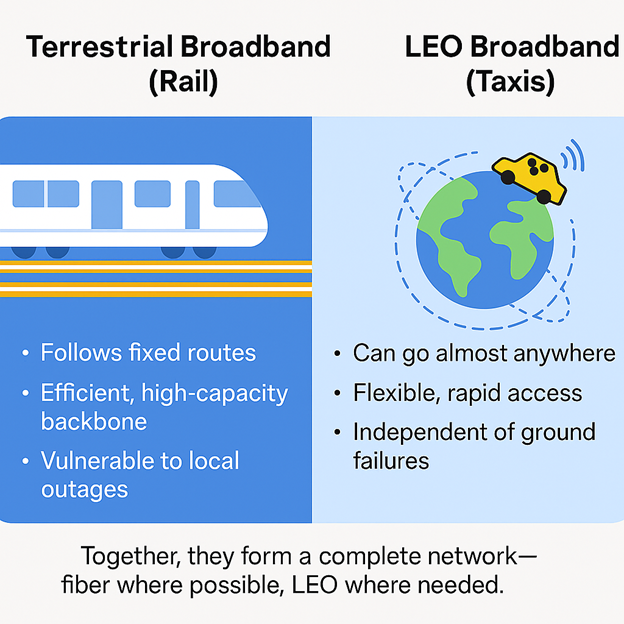
Terrestrial networks—fiber and cable—have historically been the backbone of global connectivity. They scale like rail systems: efficient, high-capacity, and built to move large quantities (in this case, data) across established engineered corridors. But laying fiber across tundra, desert, oceans, or disaster zones is expensive and slow, and for millions in rural or tribal regions, those tracks may never get built.
Satellites have historically provided coverage to some of the world’s most remote areas, offering a reliable but limited connection from high orbit. Geostationary (GEO) satellites have provided connectivity to some of the most remote locations in the world, offering broad coverage from space. But at ~36,000 km away, signals take a long time to make the round trip—and latencies over half a second turn video consults into a frustrating, stilted experience.
Low Earth Orbit (LEO) satellites change that equation. With an orbital distance of just a few hundred miles and operating in constellations, these satellites can provide connectivity to very remote locations. If terrestrial broadband is like rail, these LEO satellites behave more like a fleet of taxis: nimble, responsive, and able to go places the rail system can’t reach. LEO constellations can deliver connectivity with high speeds and low latency to clinics, homes, and mobile endpoints far from terrestrial infrastructure. This ability to deliver high-speed internet to remote areas enables new models of healthcare delivery and more consistent outcomes in underserved regions.

Benefits and Challenges
Like any emerging technology, LEO connectivity brings clear advantages but also notable limitations.
Benefits
- Lower latency and faster speeds compared to GEO.
- Potential for global coverage, including underserved and remote areas.
- Scalability: constellations can expand as demand grows.
Challenges
- Costly to deploy and maintain thousands of satellites.
- Regulatory approval and spectrum management hurdles.
- Orbital debris and congestion risks.
- Service quality may fluctuate based on
- Satellite density
- Local ground station capacity
- Weather conditions.
Access and Availability
LEO networks are not yet universally available. Coverage depends on constellation maturity and regulatory approval in each country. Starlink currently offers the broadest global footprint, while other providers are still expanding their coverage area. Access methods range from fixed installations for homes and clinics to portable “case-based” kits for mobile field use.
Quality
LEO promises near-fiber quality, but actual performance varies:
- Speeds: Consumer-level plans often deliver 50–250 Mbps, with enterprise tiers exceeding this.
- Latency: Typically 20–50 ms, far lower than GEO and sufficient for real-time video, telehealth consultations, and IoT monitoring.
- Up-Time and Congestion: Reliability depends on constellation density and ground station capacity. Peak-hour congestion or adverse weather can impact performance. In areas already oversubscribed it may be difficult to obtain service at all until more capacity is added.
Costs
Consumer plans are trending around $100–$150 per month, plus equipment costs for terminals and antennas. Enterprise and government users pay more for guaranteed bandwidth and service-level agreements (SLAs). Cost remains a barrier in low-income regions, though scaling and competition are gradually reducing prices.
LEO with Terrestrial
It is important to note that the benefits of terrestrial and LEO connectivity are complementary. A blended approach allows both flexibility and reliability. LEO extends reach beyond terrestrial infrastructure, and terrestrial infrastructure delivers capacity where LEO may be less efficient.
What is impacting the adoption of this technology?
What is Driving Adoption of LEO?
The rise of LEO broadband isn’t just a fluke of innovation—it’s the result of converging forces: new technology making it feasible, new policies and funding making it scalable, and rising healthcare demand making it urgent.
Emerging Technology
- Reusable Rockets: Lower launch costs (thanks to Falcon 9 and similar systems) make it viable to deploy massive constellations.
- Satellite Miniaturization: Smallsats/cubesats cut material and launch costs, allowing faster scaling and easier refresh cycles.
- Phased Array Antennas: Smarter ground tech makes moving-satellite connections seamless—essential for applications like telehealth where a dropped signal can mean a failed consult.
Policy and Infrastructure Funding
- BEAD and Beyond: The Broadband Equity, Access, and Deployment (BEAD) program and similar national initiatives are pumping billions into broadband expansion. BEAD recognizes that satellites, including LEO systems, can fill last-mile and hard-to-reach communities.
- Regulatory Shifts: Governments are accelerating licensing and spectrum access to encourage competition and reduce bottlenecks.
Increasing Healthcare Needs
- Rural Access Needs: Rural communities continue to face a lack of provider and health service access when compared to urban communities. Additionally, rural patients may be required to travel significant distances in order to obtain care.
- Chronic Disease & Complexity: Rising rates of diabetes, heart disease, and other chronic conditions require regular monitoring and virtual visits—connectivity gaps make care for these conditions less accessible.
- Workforce Shortages: Rural areas often lack specialists and even primary care physicians. Telehealth has the potential to address this issue, but only if broadband is there to support it.
- Emergency Preparedness: In emergencies, terrestrial networks are often the first to fail. Healthcare providers—especially in rural or remote areas—need reliable systems that can be deployed quickly to maintain care continuity. LEO offers a portable, resilient option when traditional infrastructure is disrupted.
Summary:
LEO adoption is being driven by tech breakthroughs, policy and funding shifts, and healthcare demand converging at the same moment. Together, these create a unique inflection point where satellite broadband finally has the technical quality, regulatory support, and urgent use cases to matter—especially in healthcare. LEO satellite connectivity offers flexible, reliable broadband solutions that can meet growing healthcare needs and expand access to care.
What does this have to do with Telehealth?
These emerging satellite capabilities translate into tangible use cases across the healthcare continuum—from community outreach to emergency response.
Community Medicine
LEO connectivity enables remote clinics to conduct live video visits, share diagnostic imaging, and access electronic health records without relying on fragile terrestrial infrastructure. Portable kits can be deployed in schools, community centers, libraries and other shared locations, allowing health workers to connect patients to specialists. Additionally, mobile clinics, community paramedicine programs, and traveling practitioners benefit from reliable broadband in remote areas.
Rural Connectivity
Many rural and tribal communities lack reliable broadband. LEO services may bridge this gap, supporting chronic care management, virtual consultations, and health education. The ability to extend cellular backhaul—the network link that connects remote cell towers or access points to the core internet—via satellite further improves reach, enabling coverage in areas that otherwise lack terrestrial fiber or microwave connections. (See “What is Backhaul” explainer section below)
Disaster Response
During natural disasters, terrestrial infrastructure may fail. Case-based or vehicle-mounted LEO terminals provide rapid connectivity for medical teams, enabling coordination, tele-triage, and access to medical databases even in areas with no functioning cellular or fiber network. For instance, portable Starlink kits were deployed to restore emergency communications during major wildfires in California.
Terrestrial Fail-Over Connectivity
Hospitals, clinics, and health organizations can use LEO as a redundancy measure. Network outages due to cut fiber, power outages, or cellular failures can be mitigated by using a non-terrestrial connection. LEO links provide a resilient backup to maintain mission-critical telehealth services.
LEO Providers
The LEO provider landscape is evolving quickly. Some entrants are established aerospace firms expanding into broadband, while others are new ventures. Offerings can shift rapidly—even during the drafting of this article, vendors and service tiers changed. This list is representative of types of vendors and offerings at time of publication and should not be considered a definitive list.
| Providers | Service Plans | Endpoints | Cost & Availability |
| SpaceX / Starlink | Personal / Commercial | Fixed, Mobile, Case-Based, Hybrid | $100–$500+/mo; Coverage global |
| Lockheed Martin | Government | Fixed / Mobile | TBD |
| Planet Labs | Enterprise / Data Services | Fixed / Mobile | TBD |
| Vantor (formerly Maxar) | Enterprise / Data Services | Fixed / Mobile | TBD |
| OneWeb | Personal / Enterprise | Fixed, Mobile | TBD |
| Telesat (Lightspeed) | Enterprise / Government | Fixed / Mobile | TBD |
| AST Space Mobile | Partner / Integrator | Mobile | TBD |
| Thales Alenia Space | Partner / Integrator | Fixed / Mobile | TBD |
| Project Kuiper (Amazon) | Personal / Enterprise | Fixed, Mobile, Case-Based | TBD |
The market for LEO satellites is dynamic, with a mix of well-established aerospace giants and newer entrants: Reference: Competition in the Low Earth Orbit Satellite Industry | Bipartisan Policy Center
- SpaceX / Starlink
SpaceX leads the commercial LEO broadband market, with thousands of satellites in orbit and active service across dozens of countries. Starlink offers consumer kits, enterprise-grade plans, and specialized mobility solutions for maritime, aviation, and RV use. Its rapid launch cadence and integration of laser inter-satellite links set it apart. Challenges include spectrum disputes, orbital debris management, and ongoing regulatory approvals. - Lockheed Martin
Primarily known for defense and aerospace projects, Lockheed Martin is investing in smallsat platforms and partnerships to support LEO communications. Its capabilities center on integration with defense networks and resilient space architectures. - Planet Labs
While Planet’s core business is Earth observation, its massive constellation of imaging satellites demonstrates the scalability of LEO systems. Its work on data services and smallsat manufacturing could inform future communications ventures or hybrid imaging-comms payloads. - Vantor (formerly Maxar)
Vantor focuses on geospatial intelligence, manufacturing satellites, and providing high-resolution imagery. Although not a direct broadband provider, its hardware and analytics expertise position it as an important partner in the LEO ecosystem. - OneWeb
OneWeb has deployed over 600 satellites at the time of publication and aims to deliver broadband globally, with an emphasis on enterprise, aviation, and government customers. Its financial recovery after bankruptcy highlights both the volatility and potential of the sector. - Telesat (Telesat Lightspeed)
Tele-Sat is developing its Lightspeed constellation, targeting enterprise and government markets. Its focus is on high-capacity links for backhaul and mobility. Financing challenges have slowed deployment, but government partnerships may accelerate progress. - AST Space Mobile
AST Space Mobile is unique in that it aims to deliver standard 5G cellular coverage from orbit. Its partnership with AT&T FirstNet—a priority network for first responders—is currently in field trials.
- Thales Alenia Space
A major manufacturer and integrator, Thales Alenia Space supports multiple LEO projects, including OneWeb and Lightspeed. Its role underscores how large aerospace firms enable new providers to scale quickly. - Project Kuiper (Amazon)
Amazon’s Project Kuiper represents a major new entrant, aiming to leverage Amazon’s logistics, cloud (AWS), and retail reach. With over 3,000 satellites planned, Kuiper will compete directly with Starlink, but rollout is expected later this decade. Amazon’s ability to bundle services (e.g., connectivity with AWS edge computing) could reshape the market.
Types of Service Plans
As LEO systems mature, providers are differentiating offerings for consumers, enterprises, and specialized use cases, particularly in healthcare
- Personal vs. Commercial Services
Consumer plans typically include self-install kits, plug-and-play antennas, and monthly subscription pricing. Commercial services often feature higher capacity, service level agreements (SLAs), dedicated bandwidth, and integration support. For organizations where uptime and service reliability are critical—such as hospitals, clinics, or emergency services—commercial plans are often the only viable option. Consumer plans can expand access for patients, home users, and less critical applications where occasional interruptions are acceptable. - Types of Endpoints
- Fixed Satellite Terminals: Roof-mounted or ground-based dishes for homes, clinics, or schools. Useful for rural broadband.
- Mobile Dish Systems: Vehicle- or vessel-mounted antennas that auto-track satellites, serving ships, aircraft, and field teams.
- Case-Based Systems: Portable “suitcase” kits with integrated antennas and power supplies. These kits are often produced by third-party integrators and have been used in disaster response.
- Personal Portable Kits: Starlink launched the Starlink Mini satellite system, which runs off a 100W USB-C power source and can be loaded into a backpack for portable use.
- Hybrid / Cellular Integration: Some providers bundle LEO with LTE/5G connection for redundancy, ensuring connectivity when one system is unavailable, for example, Apple Emergency SOS, T-Mobile: T-Satellite, AT&T Satellite Solutions.
- Cellular Plans & Backhaul Integration
LEO can function as a backhaul for cellular towers, extending coverage into remote regions. This is especially relevant for tribal lands, rural healthcare, and underserved markets. Hybrid offerings may combine satellite with terrestrial networks to balance performance and cost.
What is backhaul?
Backhaul is the network connection that carries data between a remote access point (like a cell tower or satellite terminal) and the main core network. The term can be used for both upload and download traffic from a hub to a remote connection.
Cost and Availability
The economics of LEO are evolving rapidly.
- Pricing Models
Consumer services like Starlink generally charge a flat monthly fee with optional tiers for mobility or higher performance. Enterprise services add SLAs, higher throughput guarantees, and sometimes usage-based billing. Initial equipment costs for Starlink kits typically range from $500–$2,500, depending on configuration, mobility, and mounting. - Cost Drivers
Launch costs, spectrum licensing, and ground station infrastructure drive pricing. Economies of scale—as constellations grow—are beginning to lower per-user costs. - Availability
Coverage varies: Starlink is available on most continents, while OneWeb and Kuiper are still building out. Regulatory approvals also influence which countries can access service. Organizations should evaluate both current and projected availability before committing.
Outlook: Where Will LEO Take Us?
Low Earth Orbit broadband has already demonstrated what older satellite systems could not: fast internet with low latency in places where fiber and cellular cannot reach. For the most remote clinics, patients, and field teams, this technology can represent a transformative shift in access.
But the technology is still in its adolescence. Costs, service models, and long-term sustainability remain unsettled, and the full range of healthcare use cases is only beginning to be tested. As more providers, health systems, and governments experiment with LEO, best practices will emerge—but so will clearer boundaries on where the technology works well and where it does not.
The most realistic future is not a replacement of terrestrial broadband, but a partnership with it. Fiber and cellular remain the backbone of global connectivity—the “rail system” that moves the majority of data. LEO is the flexible complement, the “fleet of taxis” that can reach the gaps and provide resilience when the backbone falters. Together, they point toward a more continuous, reliable, and accessible connectivity landscape, one where healthcare delivery is less constrained by geography.
From time to time TAC will choose a piece of technology to show or demonstrate in the “Innovation Watch” section of our website. No endorsement of any products or services is expressed or implied by any information, hyperlink text, product, service, material or content referred to or included on, or linked from or to the TTAC web site.