
Why This Matters
Auscultation remains one of the most familiar elements of the clinical exam, but it is also one of the hardest to replicate in telehealth settings. Traditional acoustic stethoscopes rely on direct listening at the bedside. Electronic stethoscopes convert body sounds into digital signals that can be amplified, recorded, transmitted, or reviewed remotely.
For telehealth programs trying to move beyond basic video visits, this capability is appealing. Digital stethoscopes can allow clinicians to listen to heart and lung sounds during a virtual encounter, capture recordings for later review, or involve specialists in the interpretation of complex findings.
In practice, the category has evolved slowly. Early telehealth deployments often ran into challenges including inconsistent audio quality, complicated software requirements, and workflows that did not align well with clinical practice. As a result, adoption has been uneven despite steady interest.
More recently, however, the space has begun to shift. Newer solutions suggest movement toward simpler connectivity models, browser-based platforms, and support for multiple stethoscope devices rather than tightly coupled proprietary ecosystems. These changes may make digital auscultation more practical for telehealth environments, though careful evaluation is still required.
Technology Explainer 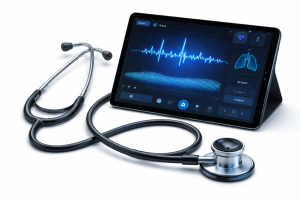
Electronic stethoscopes capture body sounds using digital sensors and convert them into electronic signals that can be amplified, filtered, transmitted, and recorded. In telehealth environments, these devices are generally used in three ways:
Local amplified listening
A clinician listens directly using the device or headphones, often with amplification and filtering to improve audibility.
Asynchronous recording and review
Audio clips are captured and stored for later playback, comparison, or specialist consultation.
Real-time remote auscultation
A facilitator or local clinician places the stethoscope while a remote provider listens live during a telehealth visit.
Real-time tele-auscultation introduces one of the most significant technical considerations in the category: how the audio signal is transmitted.
Some solutions send stethoscope audio in-band, using the same audio channel as a video conferencing platform. This approach is convenient but can introduce challenges because conferencing software is typically optimized for speech and may filter or compress subtle diagnostic sounds.
Other systems transmit auscultation audio out-of-band, using a separate application or channel dedicated to the stethoscope signal. This can preserve higher fidelity audio but often requires additional software and workflow coordination.
Another emerging shift is the growing separation between hardware and software layers. Instead of a single device performing all functions, many solutions now combine:
- A hardware capture device (the stethoscope or digital sensor)
- A software platform for streaming, recording, and review
- Optional analytics tools that assist with sound interpretation
Some newer platforms are beginning to support multiple stethoscope devices rather than a single proprietary sensor, allowing organizations to select hardware independently from software workflows.
Healthcare Use Cases
Electronic stethoscopes are used across several telehealth care models.
Telepresented clinical care
A nurse, technician, or community health worker performs the exam locally while a remote clinician listens and directs the assessment.
Store-and-forward consultation
Heart or lung sound recordings are captured and shared with a specialist for review.
Cardiac sound documentation
Some platforms focus on recording and comparing cardiac sounds over time to support monitoring or specialist collaboration.
Clinical education and training
Because digital stethoscopes can record and replay sounds, they are sometimes used for collaborative listening or teaching scenarios.
While these use cases are promising, successful deployment typically requires attention to workflow design, facilitator training, and audio transmission quality.
Key Selection Criteria
Organizations evaluating electronic stethoscopes should focus less on individual devices and more on the clinical workflow the technology is intended to support.
Important considerations include:
Transmission method
Programs relying on real-time remote listening should evaluate whether in-band audio through a conferencing platform is sufficient or whether an out-of-band audio pathway is needed.
Device compatibility
Some platforms require specific hardware, while others support multiple stethoscope devices. Greater hardware flexibility can reduce vendor lock-in but may introduce additional integration considerations.
Connectivity model
Devices now range from Bluetooth-enabled stethoscopes to USB-connected digital sensors. Simpler connection methods can reduce setup complexity but may depend on host software for processing.
Software workflow
Recording, labeling, sharing, and reviewing sounds often requires a dedicated application or web platform. Programs should evaluate how well that workflow fits within existing clinical processes.
Operational requirements
Training needs, device durability, cleaning procedures, replacement parts, and IT support requirements can all influence long-term sustainability.
Selection Criteria: Audio Quality and Sound Familiarity
Unlike many telehealth devices, the evaluation of stethoscope audio quality is partly subjective.
Nearly all modern electronic stethoscopes are capable of detecting clinically relevant heart and lung sounds. However, the way those sounds are captured, processed, and reproduced can vary significantly between devices. Amplification profiles, filtering, noise reduction algorithms, and digital processing all influence how the sound is ultimately presented to the listener.
As a result, two devices may capture the same pathology but present it differently. Clinicians who have spent years using a particular acoustic stethoscope may find that digital devices alter the tonal character or balance of those sounds. Even when the underlying signal is present, unfamiliar sound profiles can reduce provider confidence.
Audio quality is also influenced by the entire signal chain, including the transmission method, conferencing platform, headphones or speakers used by the remote clinician, and ambient noise conditions at the point of care.
Because of these variables, organizations evaluating electronic stethoscopes may benefit from allowing clinicians to listen to multiple devices directly and compare recordings in realistic clinical environments rather than relying solely on device specifications.
Advantages and Limitations
Advantages
Electronic stethoscopes can amplify subtle sounds, support recording and remote consultation, and enable auscultation during telepresented clinical encounters. In some settings, they extend specialty input to locations where clinicians may not be physically present.
Recent developments—such as browser-based platforms and broader device compatibility—may also make deployment more flexible than earlier telehealth implementations.
Limitations
Despite steady progress, the technology still has practical constraints. Audio quality can vary depending on the transmission method, background noise, and software processing. Some solutions depend heavily on proprietary platforms, while others introduce additional applications that must be supported and maintained.
AI-assisted analysis of cardiac sounds is also emerging in some systems. These tools may support screening or triage workflows but should be evaluated carefully within appropriate clinical governance frameworks.
Ultimately, the success of digital stethoscope programs often depends as much on workflow design and implementation as it does on the hardware itself.
Trends from Recent TTAC Innovation Watches
Recent TTAC Innovation Watches highlight several developments within the digital stethoscope ecosystem.
Greater hardware modularity
Some platforms are beginning to support multiple stethoscope devices rather than requiring a single proprietary sensor, giving organizations greater flexibility in hardware selection.
Out-of-band audio transmission
Several solutions are exploring ways to transmit auscultation audio outside traditional video conferencing channels in order to preserve higher-fidelity diagnostic sound.
Simplified connectivity models
Direct USB connectivity and browser-based applications are emerging as alternatives to more complex Bluetooth pairing or dedicated software installations.
Growing interest in sound analysis tools
Algorithmic interpretation of cardiac sounds, including murmur detection, is appearing in some platforms. While promising, these capabilities should be evaluated cautiously and within appropriate clinical context.
Taken together, these trends suggest a gradual shift toward more modular telehealth auscultation systems that combine hardware capture devices with software platforms and analytic tools.
Related Resource
This Technology Snapshot provides a high-level overview of the digital stethoscope category.
For organizations considering deployment, TTAC’s Electronic Stethoscope Toolkit offers a more detailed review of device capabilities, implementation considerations, and evaluation criteria to support telehealth programs assessing this technology.