The Most Important Technology Assessment Step Happens Before the Vendor Meeting
October 21, 2026
Define the Problem Before Evaluating the Solution
The Email That Wasn’t Really About a Vendor
It started with a familiar email:
“Hey, I saw this at a conference. It has several features we could use. How fast do you think we could get it set up? I scheduled a call with the vendor on Thursday. We can talk specifics after that.”
The sender is an influential champion of new ideas, with a track record of turning promising concepts into projects. When they get excited about a technology, it tends to move forward. But the proposed vendor meeting is only a few days away.
You face a familiar dilemma: push back and risk appearing to obstruct progress, or move forward before anyone has established whether the technology addresses a real need.
Rather than accept the invitation immediately, you ask about the current workflow, the tools already in use, who owns the process, and the challenges people are trying to address. Most importantly, you ask whether the situation calls for new technology at all.
You acknowledge the product’s potential and propose a more realistic timeline for the vendor conversation. First, you will speak with the people who manage and use the workflow, document the constraints, and identify what an improvement would need to accomplish. The executive agrees.
The response buys you something valuable: time. Not unlimited time, but enough to begin asking the questions that should come before any product demonstration. Now the real work begins.
Conversations with subject matter experts uncover details the vendor material cannot: existing workarounds, operational limits, and tools that may already address part of the need. With that context, the team can evaluate a product against a defined problem rather than search for a problem that fits the product.
The Common Mistake: Starting with the Solution
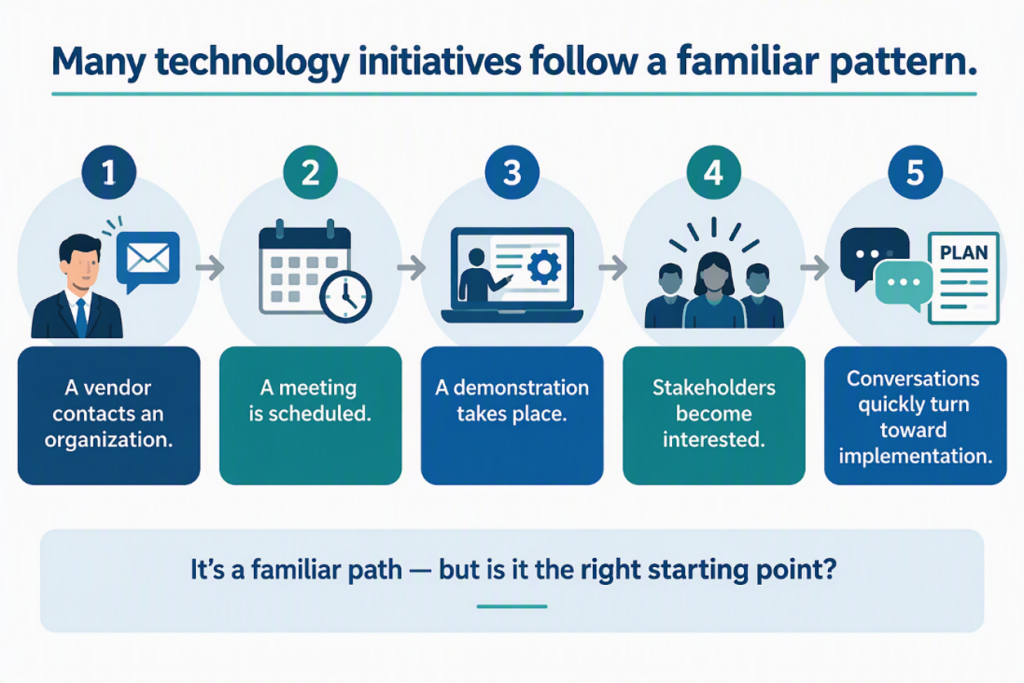
Technology initiatives often move from an introduction and demonstration directly into implementation planning. The graphic below illustrates the familiar progression. The problem is not meeting with a vendor; it is allowing enthusiasm for one product to dictate the agenda before the organization has defined its needs.
The starting question should be “What need are we trying to address?” rather than “Can this technology work here?”
Define the Need Before Evaluating a Product
TTAC’s Technology 101 Assessment Checklist begins with “Define the Need.” This means describing the problem or opportunity, documenting the current workflow, identifying affected stakeholders, and clarifying the desired outcome before comparing products.
The assessment should also consider organizational constraints, clinical and operational goals, and existing tools. These factors help determine whether a proposed technology is appropriate or whether a nontechnology solution would be more effective.
A clearly defined need gives the eventual vendor conversation a purpose: testing fit, not collecting features.
Engage Subject Matter Experts Early
Vendors know their products. Subject matter experts know the environment where those products would need to work. Both perspectives are important, but they answer different questions. The people who perform, manage, and support a workflow can identify where delays occur, what workarounds already exist, which outcomes matter most, and what obstacles a new solution would face.
Consider diabetic retinopathy screening. A product-focused discussion might begin with imaging features, accuracy, and integration. Those questions matter, but they are premature if the team has not established how screening currently happens.
A stronger conversation starts with understanding the current process. Who performs the screening? How are results documented and followed up? What barriers keep patients from completing screenings? How do community partners approach the same work? Answering those questions creates the context needed to evaluate new technology and identify opportunities for workflow improvement.
The First Vendor Meeting Should Be Validation, Not Discovery
The first vendor conversation is more productive when it tests an organization’s requirements instead of serving as a general product tour. Without preparation, vendors naturally lead with their features and capabilities, and the organization reacts to the presentation.
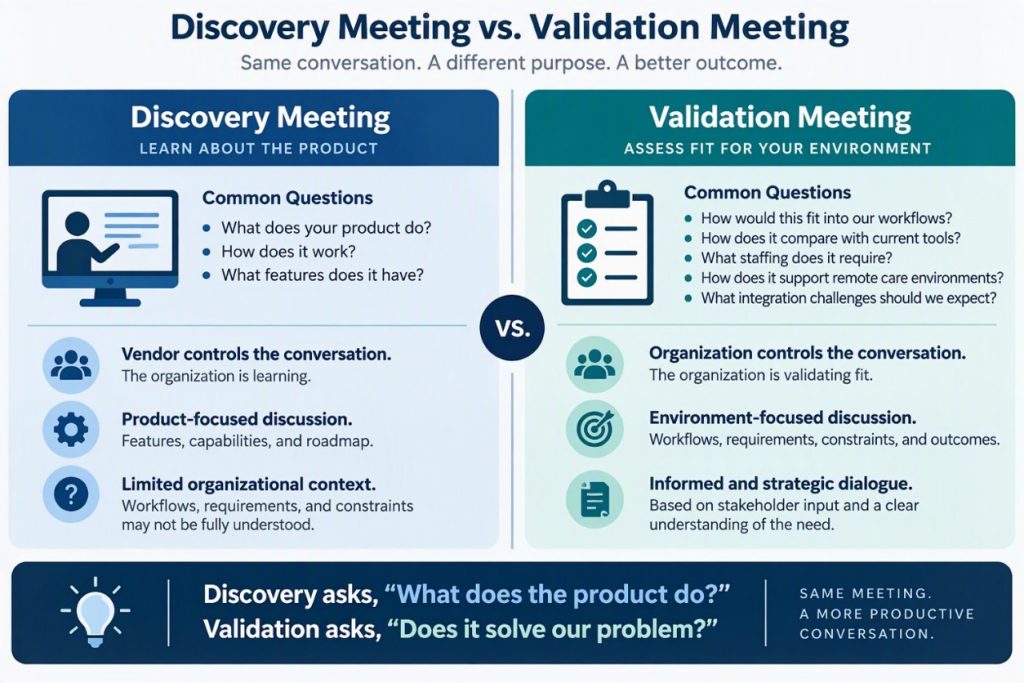
With a clearly established need, the organization can lead the conversation. Ask the vendor how the solution would fit into the current workflow. Discuss staffing needs, integration challenges, and how the technology performs in environments similar to your own. Review the evidence behind the claims. The goal is not to eliminate discovery. It is to make the conversation more focused and productive.
Five Common Pitfalls in Technology Assessment
Once a product has captured people’s attention, several things can quietly pull an assessment off course. Most are not dramatic mistakes. In fact, they often feel like progress while they are happening.
Pitfall #1: Letting the Vendor Define the Problem
A vendor’s job is to make the case for its product. Your organization’s job is to determine whether the product’s claims align with your needs. Those interests can overlap, but they are not identical. State the need in your own terms before accepting a vendor’s framing of it.
Pitfall #2: Skipping Workflow Discovery
When the current workflow is poorly understood, requirements and expected benefits are mostly assumptions. Mapping how the work is presently done is critical. Existing workarounds and recurring friction can help reveal where the problem actually begins. The goal is to differentiate a genuine gap from a perceived one.
Pitfall #3: Engaging Stakeholders Too Late
Inviting stakeholders only after a product has gained momentum can leave important requirements undiscovered and people feeling excluded from decisions that affect their work. Bring clinical, operational, technical, and other relevant voices into the assessment before narrowing the options.
Pitfall #4: Assuming New Technology Is Required
Not every problem calls for another product. Sometimes a redesigned process, better training, clearer policy, or better use of existing tools will achieve the desired result. Treat technology as one possible solution, not a magic wand.
Pitfall #5: Confusing Assessment with Procurement
Assessment asks whether an identified need warrants a technology solution and what it would have to accomplish. Procurement asks which solution to buy once requirements and the case for investment are established. Combining those decisions too early can bias the assessment toward a purchase before its value is clear.
Conclusion
The invitation to Thursday’s vendor meeting was not the real starting point. The work began with clarifying the problem, talking with stakeholders, and understanding the environment any possible solution would need to fit.
That preparation changes the conversation. Instead of asking a vendor to show what its product can do, the organization can ask whether it addresses a need worth solving. And sometimes the strongest outcome of an assessment is deciding that a new product is not necessary.
Either way, the most important work happened before the meeting.
Recent Updates
March 18, 2026
What We Learned Supporting Telehealth Technology in Rural Care
January 21, 2026
Exam Devices Resources
September 12, 2025
Direct to Consumer Resources
September 11, 2025
Wearable Medical Devices Resources
September 11, 2025